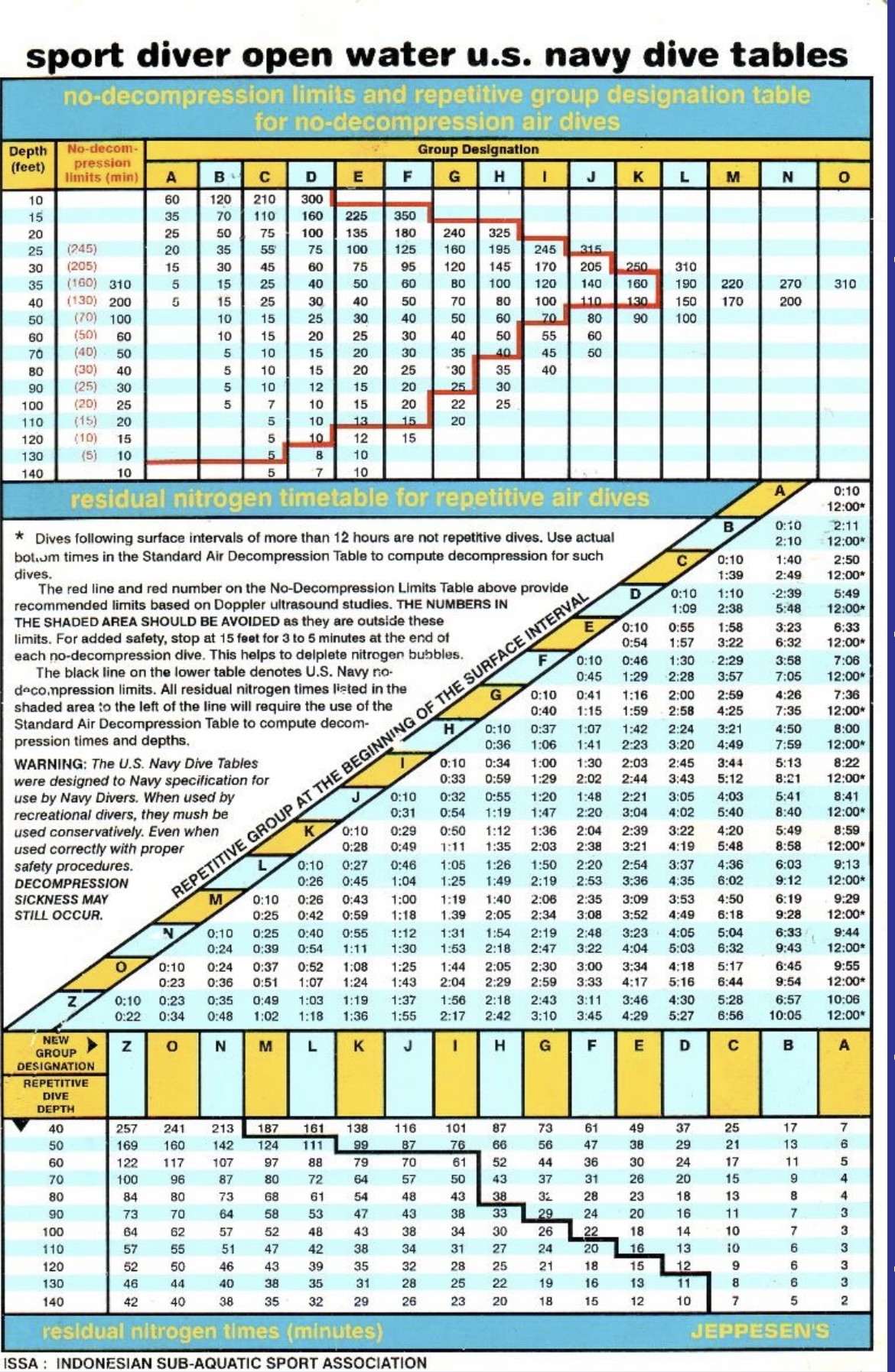
CMAS/POSSI DIVE CHART
Dive planning tables
Plan each dive. See how the surface interval changes your next bottom-time allowance.
Section 1 · Repetitive no-decompression planning
For non-military diver, use the red limits
Dive profile
Square-profile diagram · depth is proportional; horizontal spacing is schematic. Scroll sideways for longer sequences. Group boxes mark the start and end of each dive.
Your dive sequence
Example inputs are loaded. Replace them with your plan. ABT follows your training’s bottom-time convention.
Table calculations
Updates as you typeHow the calculations work
TBT = RNT + ABT · Maximum ABT = TBT max − RNT.
TBT max (NDL) is the selected no-decompression time limit at the table depth; it includes RNT. A negative allowance means there is no available no-decompression time; the displayed maximum ABT is capped at zero.
- Convert metres to feet (1 ft = 0.3048 m), then round depth up to the next printed row. First dives below 25 ft use 25 ft; repetitive dives below 40 ft use 40 ft because the residual table starts there.
- Round ABT up to a whole minute, then use the next group-time cell at or above TBT. Blank cells are skipped.
- For the next dive, round the surface interval down to a whole minute and look up the reduced group, then RNT at the next dive’s table depth.
- Surface intervals below 10 minutes are unsupported. Only an interval strictly longer than 12 hours clears the previous group under this chart; exactly 12 hours remains repetitive.
- If TBT exceeds TBT max, later dives are blocked. Decompression schedules, emergency procedures, ascent limits, altitude, nitrox, flying and gas reserves are outside this calculator.
“Within selected limit” describes the table calculation, not a guarantee against decompression sickness. Follow your instructor’s current procedures and track actual exposure using the same planning method.
View the official CMAS/POSSI non-decompression dive chart
Source: CMAS/POSSI dive chart.
Terminology
- RNT
- Residual nitrogen time for the next depth.
- ABT
- Actual bottom time entered for this dive.
- TBT
- Total bottom time used for the table lookup.
- TBT max (NDL)
- Selected maximum table time without required decompression.
- Group
- The table letter used to carry residual nitrogen to the next dive.
Section 2 · Decompression dive planning
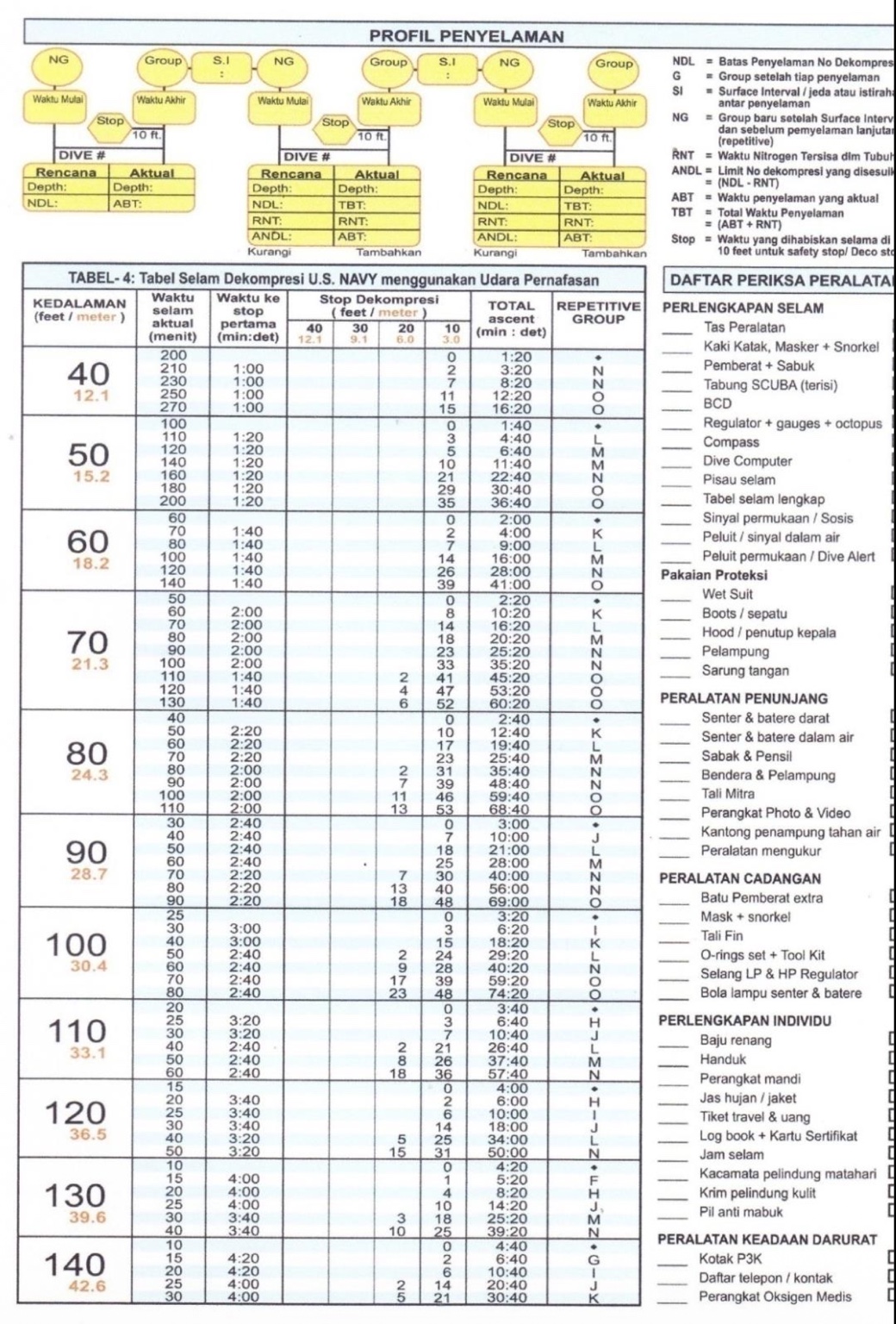
POSSI Table 4 · U.S. Navy air decompression table · Depths in feet.
Round depth up within 40–140 ft and time up to the next printed row, then advance two time rows in the same depth block. Outputs use the adjusted row. If the row is unavailable, the lookup stops. The first printed time row is accepted and receives the two-row adjustment. Inputs below that row belong in Section 1.
View the official CMAS/POSSI decompression dive chart
Source: CMAS/POSSI dive chart.
Open full-size POSSI chart